Dual Roles and Muddled Lines: When a Dissertation Chair is Not Just the Dissertation Chair

In a recent X post, a nouthetic biblical counselor, Nick Sevier, who is certified through the Association of Certified Biblical Counseling (ACBC) described me as a “woke hypocrite” because I questioned the ethics of a situation I found troubling. ACBC is a non-profit biblical counseling organization that offers a training program and certification for a nouthetic style of biblical counseling to lay counselors.
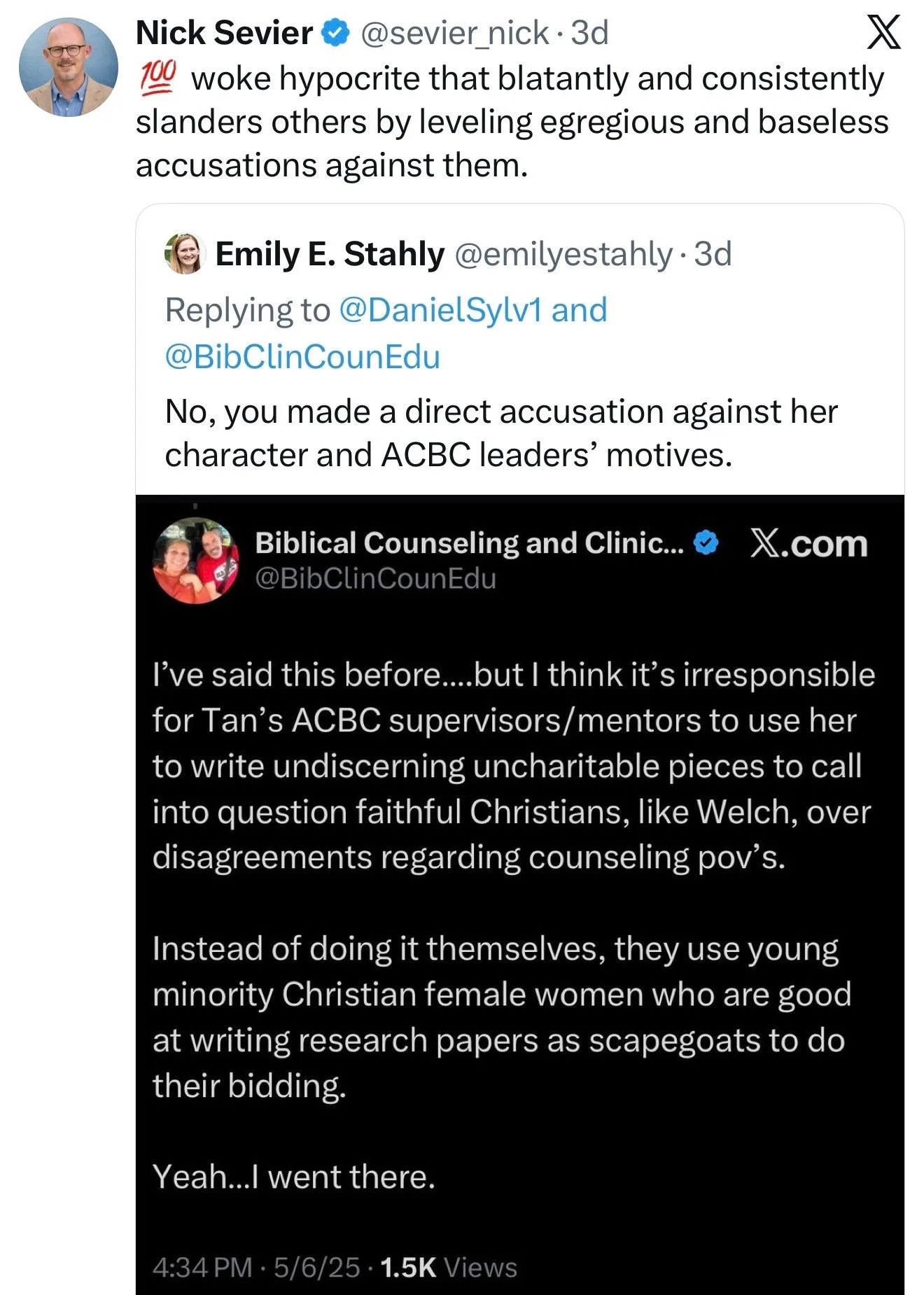
I wrote this comment back in May of 2025. I do admit I was a bit harsh and heavy handed. However, in my defense, I have tried to have online dialogue with other biblical counselors over various disagreements since I also consider myself a biblical counselor, but one who is not nouthetic. I am more clinically informed and trauma specialized in my biblical counseling modality. Sadly, when I have tried to engage in online dialogue, the conversation goes south quickly and it seems the disagreements are just too vast. Disagreements only get reinforced and add more fuel to an already volatile situation between ACBC nouthetic style counseling and clinical/trauma informed biblical counseling.
This article is me trying to unpack my May 2025 comment so that others can determine if I was “slandering and leveling egregious and baseless accusations” against the “character’ of another female biblical counselor. I was not. However, I will admit I was calling into question the motives of ACBC leadership.
Let me explain.
In most PhD programs, the dissertation chair holds an enormous influence over a student’s life. They help shape the topic that a student chooses and guides the research. The dissertation chair will also know when a student is ready to present and defend their dissertation.
So, imagine a PhD student is attending a seminary and working on an Applied Theology degree. Imagine that student has been a certified ACBC biblical counselor since 2019 and apparently enjoys it so much, she decides to start working for the non-profit biblical counseling entity.
Now also imagine that student’s boss, who is not only the executive director of the non-profit where the student is employed at, but also sits on the board of trustees for that same non-profit. If that were not enough, imagine that same executive director is the Director of Counseling at the school where the student attends and is also an associate professor in the counseling department of the school she attends.
Let’s think about this for a second. We are talking about one individual who simultaneously holds three formal authoritative positions over another individual.
The person in authority was none other than Dale Johnson. He was a faculty authority, a dissertation authority, and an employment and organizational authority over his student, his doctoral supervisee and his employee, Francis Tan. This level of overlap is not typical. In most higher education context, this would trigger a serious conflict of interest review.
To understand why this authoritative structure is ethically high risk, let’s unpack this a bit.
In most universities, these roles are deliberately separated because each carries independent authoritative oversight. As an associate professor, he or she influences the department culture, academic evaluation standards, student progression, etc. As a dissertation chair, he or she controls research direction, draft evaluation, and defense readiness, not to mention a student’s future vocational aspirations. As an executive director and program director, he or she controls salary, job stability, performance reviews, organizational visibility and public reputation within the biblical counseling world.
When one person holds all three roles over the same person, the authority umbrella is bigger…consolidated, while at the same time concentrated.
This conflict of interest increases risk, meaning the supervisors institutional interest, the employer’s organizational interest, and the professors academic authority are embodied in the same person. Even if that person is ethical and well-intentioned, the influence that one person has on another person is strained.
In most research universities, faculty are required to disclose outside employment that intersects with student supervision. Supervisors are often prohibited from serving as the primary evaluator when a financial relationship exists. I am not privy to whether or not Tan was a paid employee of ACBC during the dissertation process. Maybe she was a volunteer. Still, conflict of interest committees can require recusal or co-chair arrangements. In this case, the co-chair of her dissertation was also strongly affiliated with the school and the ACBC organization. Furthermore, marketing use of student research by affiliated entities would be scrutinized. It is well known that Tan’s research was used prior to the final defense of her dissertation, which highlights that conflict of interest.
The reason for all this oversight:
· When a professor is also an employer, the student’s capacity to disagree becomes compromised and the employee can have a sense of not being able to resist expectations, even when the expectations are informal or loosely suggested.
The ethical question becomes: Can a student meaningfully say “no” to someone who also determines both their degree and their livelihood?
In this situation, if the boss tells you what direction your dissertation should take, can the student/employee freely say no and choose a different route.
If the student disagreed with the chair’s feedback, where does that tension go? Does it stay in the classroom, or does it follow the student into their work environment?
If the research challenges the counseling framework of the organization that employs the student, what happens?
Much of the doctoral ethics research says that when dissertation supervision starts to feel like an employer relationship, students often feel they can’t fully resist expectations, even if those expectations are subtle. It does not require abuse to exist. It only requires….dependency.
If the student’s work diverged from the organizations’ counseling assumptions, would that affect her job?
This is why safeguards matter.
This is why safeguards at seminaries matter.
Now add to this layer the fact that Johnson is a male leader in a nouthetic biblical counseling role. Research on evangelical seminaries consistently show that women often feel additional pressure to “makes themselves small,” also known as presenting themselves as “meek and submissive” in environments shaped by strong male leaderships cultures. So, when a female student’s role and research findings are shaped to directly support the institutional voice of the executive director/institutional authority/academic authority, especially when the goal is to promote her publicly as the “expert” on trauma, this muddles the situation even more.
This authoritative conundrum is no longer subtle. It is comprehensive.
Even if the student experienced the relationship as positive, the ethical standard is not whether she felt harmed. The standard is whether the institution (seminary) created an environment where a student’s independence was protected, not led by another.
Even if every action was done in good faith, the issue of credibility arises. This credibility is questioned if
· The executive director chairs the dissertation
· The dissertation topic aligns with the executive director’s counseling framework
· The biblical counseling organization markets the student as the expert
· The student worked for the executive director while working on the dissertation
· Post dissertation, the student now works in publications under the executive director
This scenario raises some questions:
Was the research independently evaluated? Or was it aligned with the organization or institution?
Southern Baptist polity tends to resist concentrated authority. The historic Southern Baptist instinct has always been that there is no bishop over churches, no centralized ecclesiastical control and authority is dispersed through accountable bodies.
Yet in the situation described in this article, one person had concentrated control over another person regarding their academic formation, their organizational employment, and now their public ministry presence and publication of their writing.
Since Southern Baptists tend to resist allowing concentrated authority as a default of Baptists polity, they operated contrary to their own ecclesiological instincts.
The issue is not whether Johnson intended to harm or jeopardize Tan’s credibility in any way vocationally?
The issue is whether the seminary’s Southern Baptist governance provided best practices.
Why This Matters For Theological Education
Seminaries are forming church leaders, pastors and counselors. If doctoral programs normalize where authority is concentrated, institutional benefit overlaps with academic evaluation, subordinates are dependent across multiple domains, then future church leaders will mimic those patterns in their churches and ministries. If theological education does not model transparent, limited, accountable authority, it weakens its own witness.
This is not just about one professor and one student. It’s about what seminaries model. Christian authority must be willing to go the extra mile to be protective, not possessive. It must be transparent, not entangled. Christian ministry is not upheld by influence, but by integrity.