When Biblical Counselors Argue Past Each Other
I am trying to follow the advice of other scholars who wrote their dissertation during the modern era of social media reactivity. My brain cannot process too many online arguments while also trying to stay focused on the section I am currently working on in my literature review. However, I recently came across a response from an ACBC counselor (Sean Perron) to a more clinically informed biblical counselor (Jason Kovaks)….meaning Jason posted his comment first and then Sean responded.
As someone whose dissertation is on the topic of understanding how the body should be addressed in biblical counseling, I could not help but notice something that is becoming a common theme in these discussions.
Oftentimes, I am seeing conversations shift away from the actual argument being made and this interaction between Sean and Jason is a classic example.
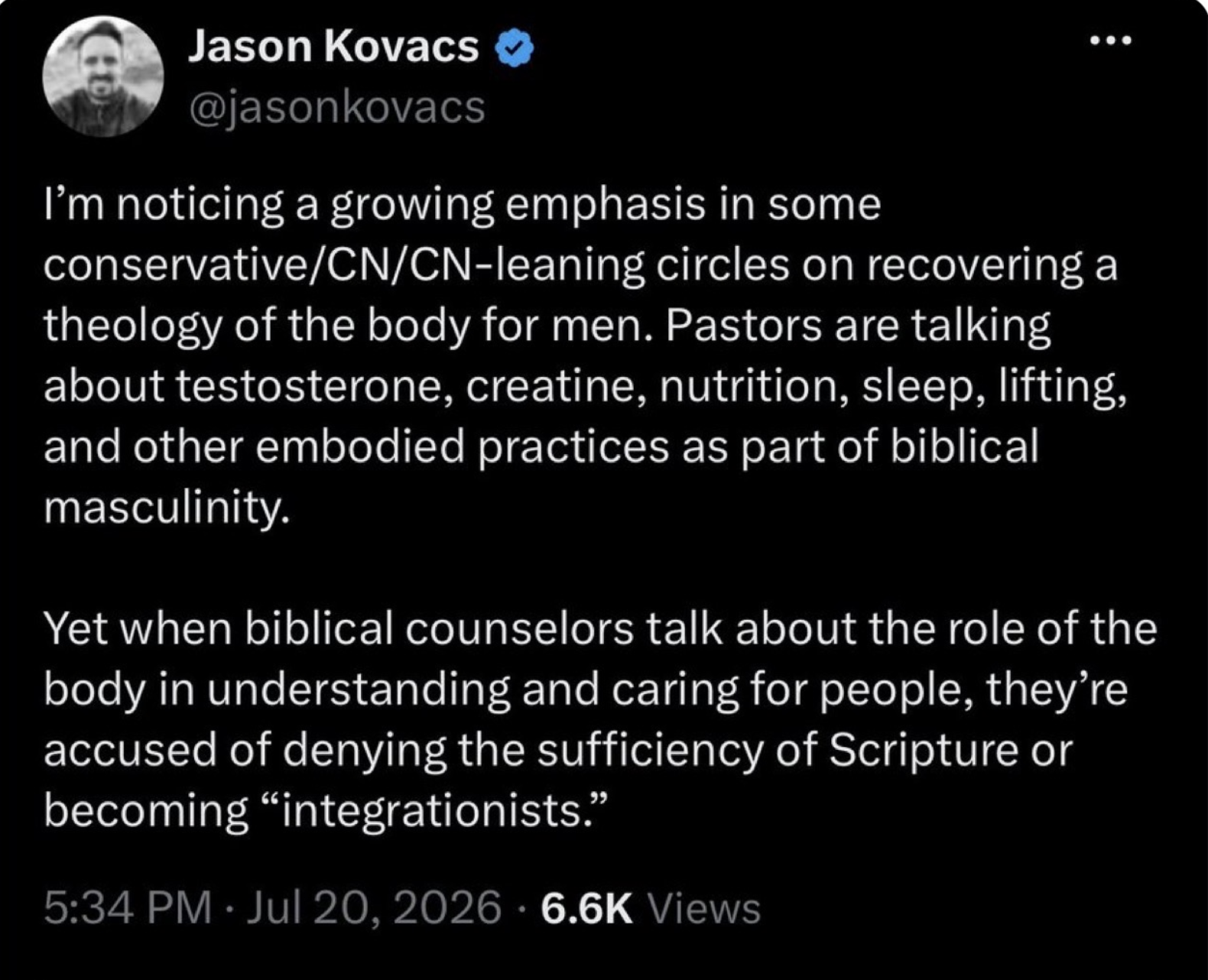
Jason’s original observation was pretty straightforward. He noted that many conservative Christians who lean more towards a Christian nationalists stance, have become more comfortable talking about embodied stewardship, like expressing the value of exercise, sleep, testosterone, nutrition, lifting weights, and other aspects of caring for the body as part of the discussion on masculinity.
However, some of these same voices who affirm addressing the embodied masculine body in Christian settings, they are often not as welcoming when addressing the body’s role in understanding fear, trauma, or human functioning. These voices often accuse clinically informed biblical counseling as abandoning the sufficiency of Scripture or becoming “integrationists.” (Kovaks, 2026).
Whether one agrees with Jason’s observation is an issue in and of itself but Sean’s response did not actually address the issue Jason brought up in his post.
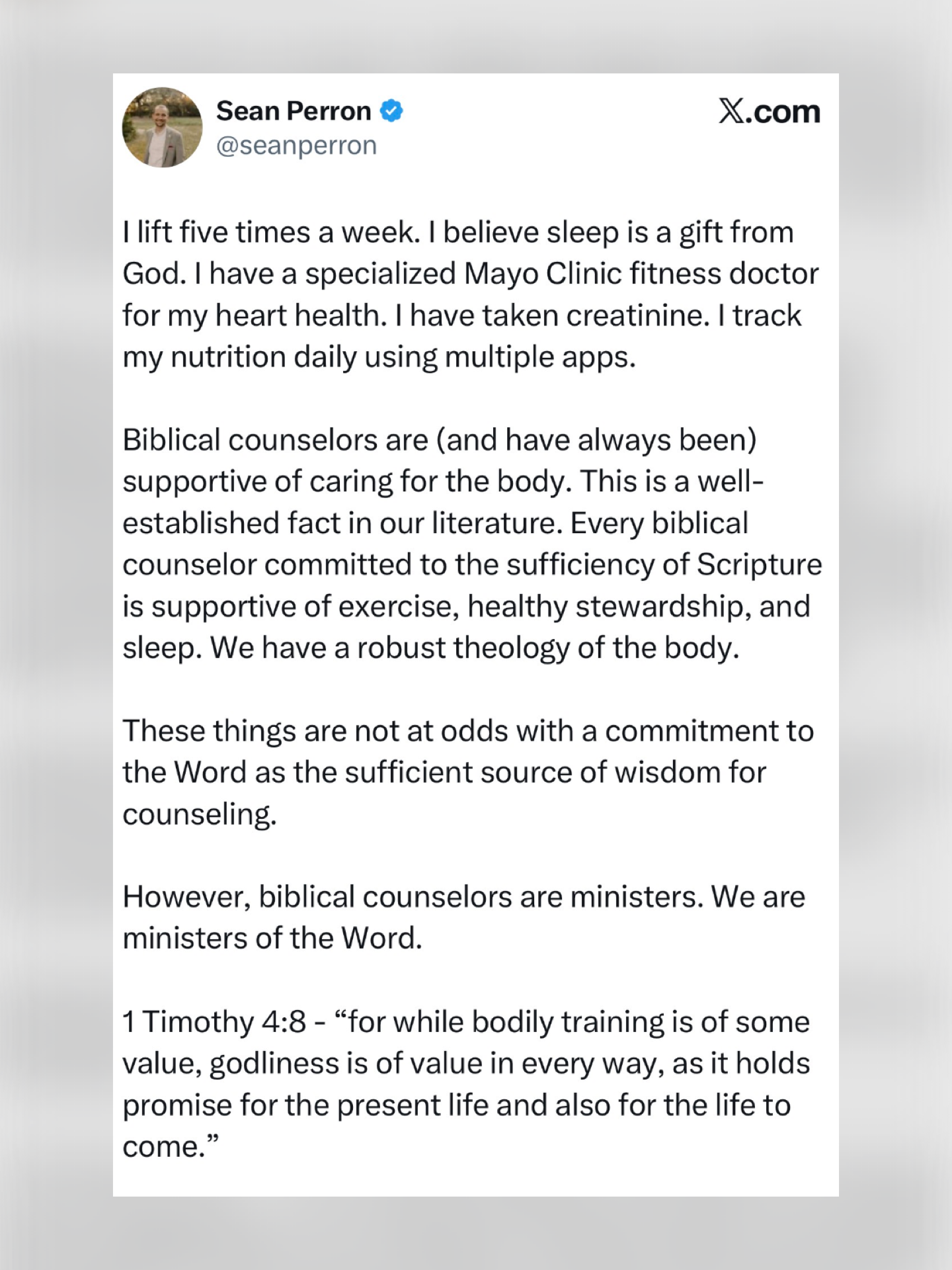
In this first part part of Sean’s response, it becomes apparent that he is addressing a completely different argument. Sean is affirming that he welcomes caring for the body in all the various ways he is doing it for his own body. This rightly emphasizes that biblical counselors have always affirmed caring for the body in various way. At this point, I don’t see a meaningful disagreement between Sean and Jason…but I also don’t think Sean’s personal care for his own body is the point Jason was making.
The conversation then changes in the second half of Sean’s response.
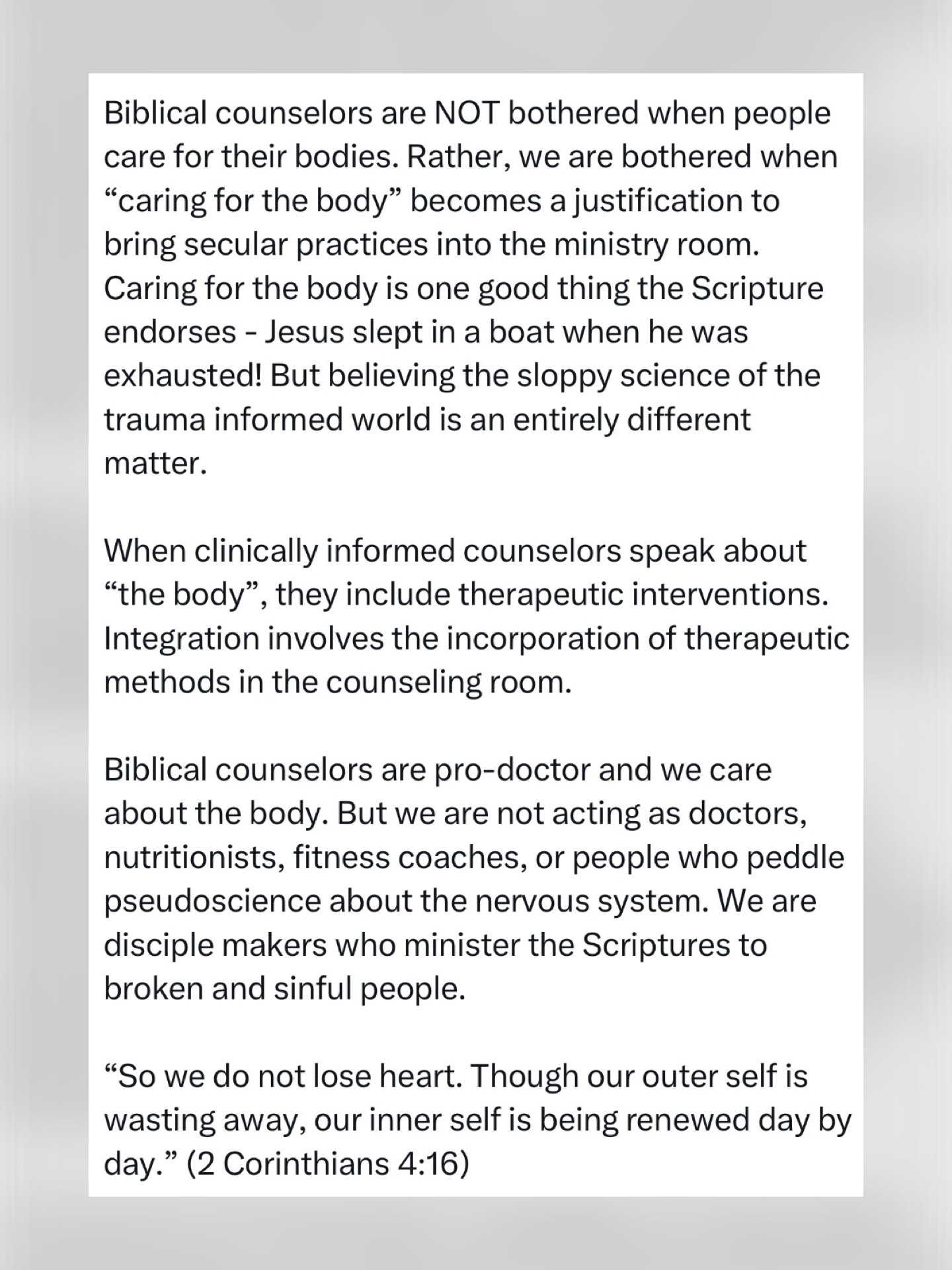
The response shifts from Jason’s original claim to counseling interventions, secular models, and “bringing secular practices into the ministry room” to address what he calls “the sloppy science of trauma informed world”
Understanding the body is not synonymous with adopting secular psychotherapy. Likewise, acknowledging findings from neuroscience is not the same thing as importing secular worldviews into biblical counseling. Those are two very different categories.
We can affirm that sleep deprivation affects judgment. We can recognize that chronic pain influences emotional endurance. We can affirm that cortisol affects attention and traumatic experiences do indeed influence the body’s physiological threat response. We can and do encourage those we counsel to seek physicians, address hormonal deficiencies, exercise, and eat wisely. None of these practices threaten the sufficiency of Scripture because Scripture was not intended to function as a medical textbook.
These things can be affirmed without adopting secular therapeutic interventions.
These realities are observations about how the Fall made human bodies finite creations.
I totally agree that there is plenty of poor trauma literature. I have had to wade through so much of it over the course of my doctoral classes and now for my dissertation. It does not help when popular social media accounts oversimplify nervous system explanations, exaggerate claims about polyvagal theory, and the tendency for therapeutic trends to speak louder than actual helpful empirical studies. No wonder there is so much criticism amongst Christians. Christians should not be naive consumers of popular trauma discussions coming from Instagram or TikTok.
But describing the entire trauma-informed world as “sloppy science” paints a far too broad of a brush. Trauma research is not a single theory or movement. It encompasses decades of work across neuroscience, developmental psychology, neurobiology, endocrinology, cognitive science, and longitudinal developmental reserach. Some theories are stronger than others. Some deserve rejection. Others have been replicated repeatedly and are now foundational to our understanding of how the brain and body respond to overwhelming stress.
Good scholarship requires us to distinguish between weak theories, speculative therapeutic models, and well-established empirical findings. We do not reject medicine because some treatments are ineffective, nor do we dismiss nutrition because fad diets exist. Likewise, we should be careful not to dismiss an entire body of trauma research because portions of it are overstated or poorly supported.
What makes this conversation particularly important is that many within the ACBC movement, of which Sean is a part of, appeal to Francine Tan’s doctoral research as support for rejecting broad portions of trauma theory as pseudoscience. Yet the same movement routinely appeals to empirical research when discussing sleep, nutrition, exercise, cardiovascular health, hormones, and medicine. If empirical research is a legitimate source of descriptive knowledge in those areas, then the burden of proof is not met by broadly labeling trauma research “sloppy science.” The individual claims must be examined according to their methodological validity
No responsible scholarly approach should evaluate an entire multidisciplinary field through one dissertation, one published critique, or one counseling movement’s interpretation of that work. Trauma literature includes competing theories, differing research designs, varied levels of evidentiary support, and multiple disciplines. Some claims are speculative and should be rejected. Others are supported by substantial empirical research. Good scholarship requires engaging those distinctions rather than treating “trauma theory” as one unified and disproven system.
When Sean writes “when clinically informed counselors speak about the body, they include therapeutic interventions,” which just is not universally true.
Unfortunately, discussions like these often collapse three very different categories into one.
First, there is medical stewardship—exercise, sleep, nutrition, endocrinology, physicians, and medications.
Second, there is scientific description—neuroscience, physiology, learning, memory, autonomic regulation, and stress responses.
Third, there are psychotherapeutic methodologies—specific counseling models, techniques, and interventions developed within various psychological traditions.
These categories should not be treated as though they are all the same thing.
A biblical counselor may reject particular therapeutic methodologies while still affirming that neuroscience offers accurate descriptions of how God designed the human nervous system.
Likewise, one may appreciate research on learning, memory, or stress physiology without granting these empirical disciplines to have authority over anthropology, sin, sanctification, or the gospel.
This is where I think much of the conversation needs better clarity. The issue is not whether Scripture is sufficient.
It is.
The real question is: sufficient for what.
Scripture is sufficient to reveal God, define sin, proclaim Christ, shape wisdom, direct sanctification, and equip the believer for every good work.
But Scripture never claims to exhaustively explain every mechanism within God's created order.
It tells us that human beings are embodied souls.
It tells us why fear, suffering, and death exist.
It tells us how Christ redeems sinners.
It does not attempt to explain synaptic plasticity, endocrine signaling, immune responses, vestibular processing, or the neurobiology of memory formation.
Those belong to general revelation.
In my view, the better question is not whether biblical counselors should "use neuroscience."
The better question is whether biblical counselors can distinguish between describing God's creation and differentiating counseling ideas from secular worldviews.
Those are not the same activities.
As my dissertation has progressed, I have become increasingly convinced that many disagreements stem less from different commitments to Scripture and more from differing assumptions about the relationship between theology, science, and common grace.
Theology and neuroscience are often treated as competitors when, in reality, they are answering fundamentally different questions.
Theology tells us what it means to be human before God.
Neuroscience helps us understand some of the ordinary biological processes through which embodied humans think, remember, perceive, learn, and respond to the world.
In fact, a robust Reformed doctrine of creation gives us every reason to expect that careful study of God's world can help reveal various aspects of God's design—while never replacing Scripture as our ultimate authority for faith and practice.
Counselors who are also biblical can affirm the helpfulness of medical stewardship (sleep, nutrition, hormones, exercise, doctors, medications), as well as understanding God’s creation scientifically (neuroscience, stress physiology, learning, memory, attachment, autonomic nervous system), but still reject the use of therapeutic methodologies (EMDR, IFS, DBT, ACT) in our own counseling care.
Though I personally do not use any of these specific modalities in my counseling care, I carefully discern what types of interventions I suggest with those I counsel. However, I unapologetically affirm the first two areas, medical stewardship and scientific understanding of God’s creation.
To be clear, this post is not about affirming this or that modality or intervention wholesale….but I refuse to uncharitably accuse Christians, brothers and sisters in Christ, who do use them as “secular” or derogatorily label them as an “integrationists.”
Lastly, I think these types of conversations would be more productive if we spent less time assigning labels like "integrationist" and more time charitably engaging in fruitful conversations. Otherwise, we risk arguing past one another rather than engaging the actual claims being made.
From where I sit, distracted by my dissertation, the real divide is not between people who believe in Scripture and people who believe in science. It is between those who see theology and empirical observation as competing sources of authority and those who believe, following the historic Reformed doctrine of general and special revelation, that each has a distinct role under the lordship of Christ.
For the record, Sean himself appeals to empirical science when he mentions exercise, sleep, nutrition, heart health, and physicians. Those recommendations are grounded in research, not derived directly from Scripture. If empirical research is a legitimate source of descriptive knowledge about cardiovascular health or sleep physiology, then the burden of proof is to explain why neuroscience or trauma research should be categorically excluded. The issue is not whether empirical science can describe aspects of God's creation, but which empirical claims are well-supported and how they should be interpreted under the authority of Scripture.
All this to say….this is why I prefer the language of clinically informed biblical counseling rather than simply trauma-informed counseling. My goal is not to baptize every contemporary trauma trend.
Rather, it is to exercise theological discernment—to receive what careful empirical observation can legitimately tell us about God's created order while rejecting any worldview assumptions that contradict Scripture. The question is not whether all trauma research is correct. It clearly is not. The question is whether biblical counselors should dismiss an entire scientific literature because some portions of it are methodologically weak. I do not believe that is consistent with either good scholarship or a robust doctrine of common grace.
A robust doctrine of common grace means Christians should neither baptize every scientific claim nor dismiss scientific observation simply because it originated outside the church. Instead, every empirical claim should be tested, discerned, and interpreted within a biblical doctrine of creation, fall, and redemption.
Good theology should make us better interpreters of science, and good science should never tempt us to become worse interpreters of theology.
***These occasional reflections represent ideas I am exploring as part of my larger research project and are intended to encourage thoughtful dialogue among Christians.